

Book cover ideas can stop a reader mid-scroll, but artwork alone cannot identify your audience. In 2025, U.S. publishing revenue reached $33.4 billion, according to the Association of American Publishers, while Circana BookScan recorded 762.4 million print books sold through its reporting outlets. Neither figure proves that a cover increases sales.
Your design must communicate genre, mood, and a reason to look closer, whether seen on a phone, in search results, or on a bookstore shelf. For any genre today, stand out without confusing readers. Here are 25 concepts, design insights, and testing tips.
25 Book Cover Ideas That Give Readers a Reason to Look Twice
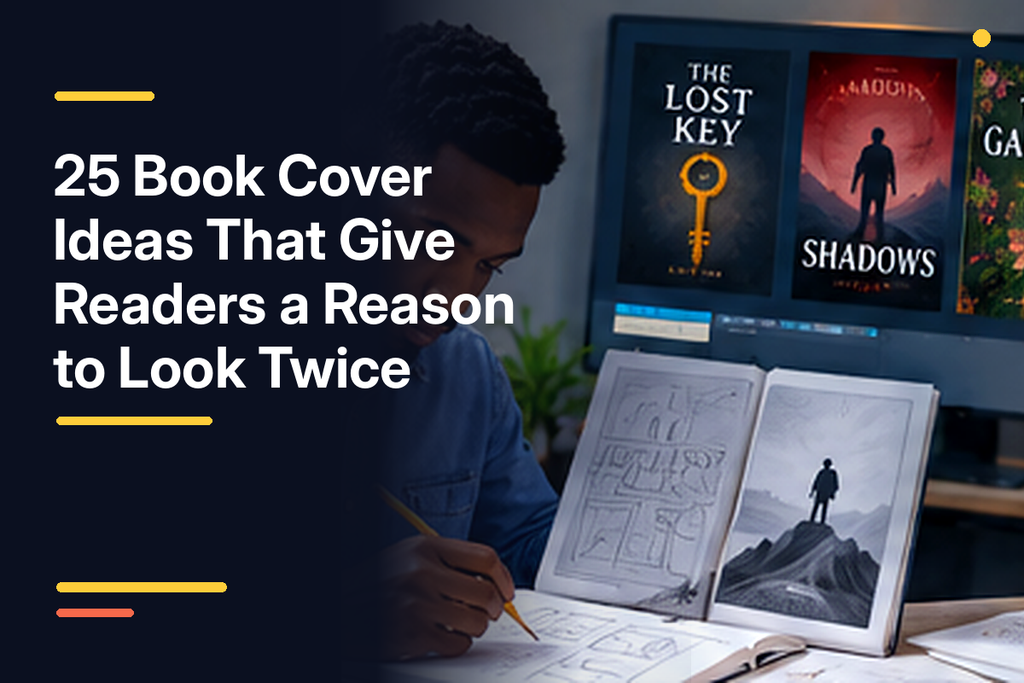
A cover makes one promise, not a plot summary. Adapt these concepts with your own imagery, colors, and lettering. Choose what serves the book, not what looks flashy in isolation.
- Single symbol: A cracked key or paper crown.
- Oversized title: Typography as the main artwork.
- Silhouette: A character suggested, not revealed.
- Hidden doorway: An invitation into the unknown.
- Split portrait: Two identities or conflicting choices.
- Cut-paper layers: Tactile shapes and gentle depth.
- Hand-drawn map: A journey without spoilers.
- Unexpected scale: One tiny object made enormous.
- Negative space: An image concealed inside another.
- Vintage label: Restrained historical detail.
- Botanical shadows: Beauty with an uneasy edge.
- Night skyline: One illuminated window.
- Illustrated couple: Romantic tension or humor.
- Geometric blocks: Clear, confident nonfiction.
- Personal objects: A memoir told through possessions.
- Underwater view: Isolation or discovery.
- Distant landscape: Atmosphere and longing.
- Digital glitch: Technology or instability.
- Playful sketch: Personality for young readers.
- Broken pattern: One element that refuses to conform.
- Framed window: A glimpse of another world.
- Monochrome portrait: Emotion through texture.
- Lettering maze: A title that becomes a puzzle.
- Illustrated ingredients: A memorable cookbook identity.
- Series emblem: A repeatable visual signature.
Sketch three directions before polishing one. A Professional KDP cover creator can generate concepts and prepare cover designs. Check the lettering, artwork, and dimensions before publishing.
Must-know Tip: The cleverest visual is not necessarily the best-selling signal. The wrong genre signals mislead readers. Prioritize clarity over decoration.
How to Match Book Cover Examples to Your Genre and Readers

People recognize genres through combinations of visual clues. A cozy mystery and thriller may share a plot but require different moods. Study recent book cover examples in your subgenre.
Genre-Specific Concepts Worth Trying
- Romance: Intimate photography, illustrated couples, expressive titles.
- Thriller: Stark lighting, uneasy shadows, restrained imagery.
- Fantasy: Intricate emblems, strange landscapes, symbolic artifacts.
- Science fiction: Cosmic scale, geometry, unfamiliar technology.
- Memoir: Personal objects, evocative portraits, subtle lettering.
- Self-help: Bold promises, simple visual metaphors, clarity.
- Children’s: Expressive characters and age-appropriate illustration.
Genre demand changes, but sales data does not prescribe a design formula. Publishers Weekly reported that romance print units increased 3.9% in 2025, while fantasy units declined 8.7% that year. Neither figure dictates artwork or colors.
Build a Small Competitor Mood Board
Collect 15 to 20 covers from your retail category, recording typography, colors, and mood. Note three familiar cues and one element you can change. Aim for recognizable yet individual work.
If you’re planning a series, identify a repeated typeface, emblem, or framing device before designing book one. Give each installment a distinct color or central object so buyers can tell them apart. This creates continuity without identical volumes.
Expert Insight: Reedsy designer Michael B. advises, “Start with the tropes, and then put your own spin on them.” This prevents interchangeable covers. Use genre cues without copying compositions.
Book Cover Trends and Color Schemes for 2026
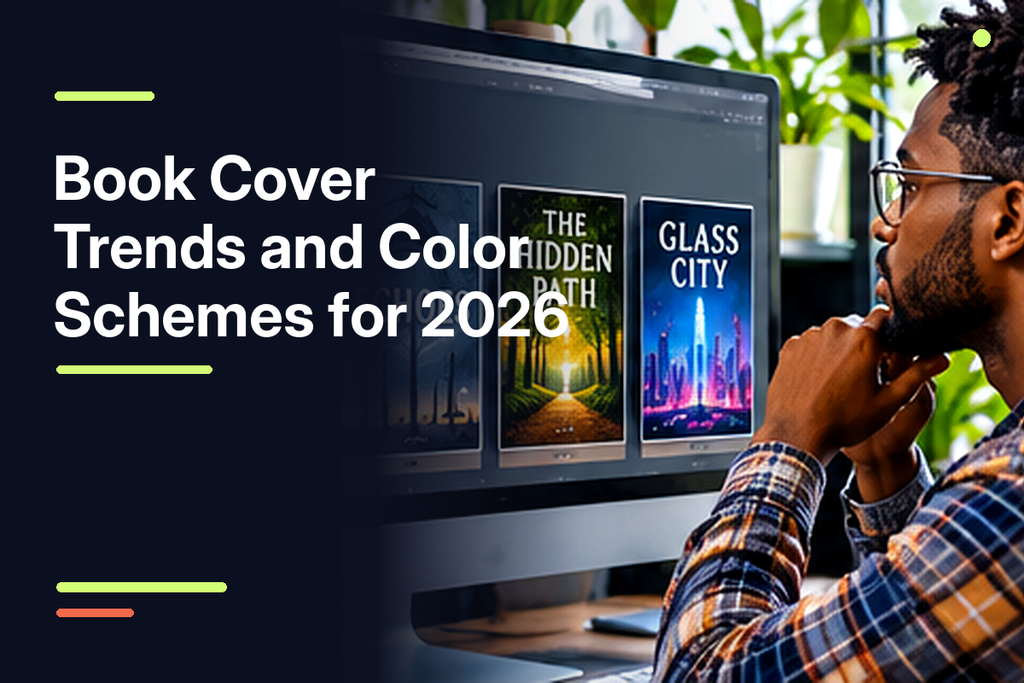
Book cover trends can suggest effective directions, but they are not rules. Reedsy’s late-2025 analysis notes minimal imagery, large type, and thumbnail clarity. All can help in crowded digital stores.
Category performance also varies. Through the first nine months of 2026, Circana data reported by Publishers Weekly showed adult fiction print sales up 7.7%, science fiction up 93.1%, and horror or occult titles up 39.4% year over year. Sales changes do not prove design trends caused purchases.
Choose Colors for Mood and Readability
Try navy and gold for historical intrigue, coral for romance, or charcoal and red for suspense. Muted green, off-white, and dark gray can suit thoughtful nonfiction without feeling dull. Book cover color schemes must support mood and readability.
Choose one strong title font and a quieter supporting typeface. At thumbnail size, fine strokes and details may disappear. Leave room for the title.
Don’t mistake a popular palette for a universal genre rule. A cheerful yellow cover can work for dark satire when its imagery introduces an unmistakably unsettling twist. Test the emotional message created by the whole design, not by individual colors in isolation.
Must-know Tip: Shrink each draft and place it beside comparable titles. If the genre or title is unclear, simplify first. Storefront clarity beats zoomed-in effects.
How to Create Covers With Templates, AI, or a Designer
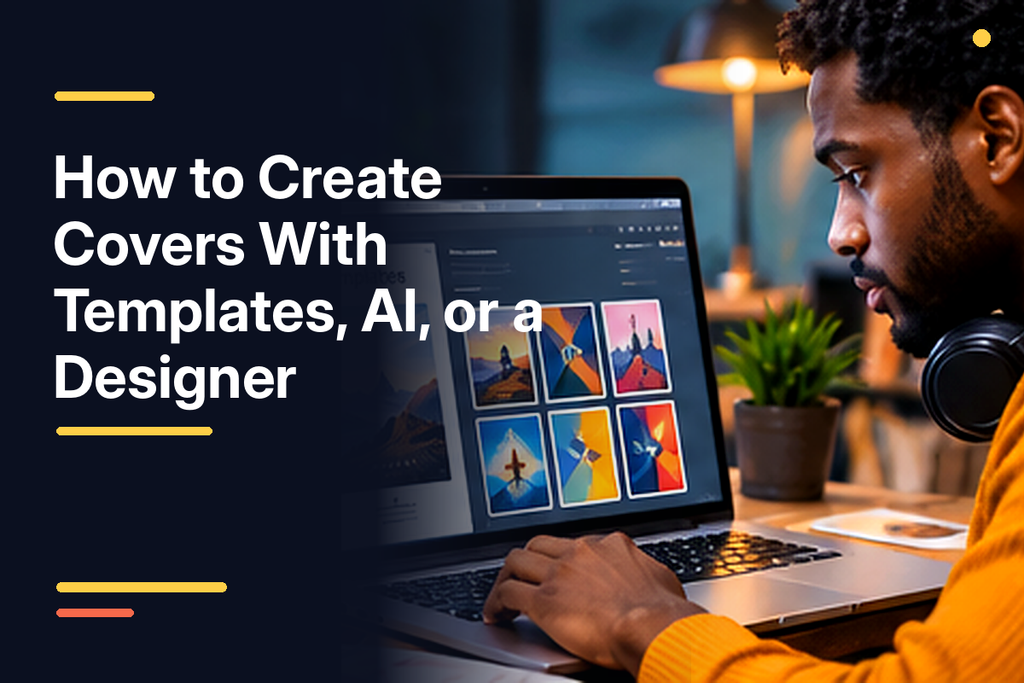
Your main options are to customize a template, refine AI-assisted artwork, or commission a professional. Book cover templates suit projects where you can change images and layout. Avoid lookalike designs.
AI tools can help visualize unusual objects, settings, and compositions, but their outputs still require careful inspection. Inspect details, text, and commercial-use terms. Set titles separately instead of trusting generated text.
Professional help is valuable for complex illustration, nuanced genre positioning, and coordinated print editions. Reedsy’s 2025 study of 9,600-plus projects found an $880 average, with most costing $625 to $1,250. These marketplace figures are not guaranteed quotes.
Give Your Designer a Useful Brief
Share a synopsis, audience, references, formats, and deadline. Confirm revisions, print wraps, files, and licenses. Specify unwanted imagery.
Compare options by total deliverables, not just the initial price. A lower quote may exclude spine design, additional formats, or another round of revisions, which changes your eventual cost. Request written ownership and licensing terms before paying, when stock photography or custom illustration is involved.
The U.S. Copyright Office explained in January 2025 that AI-assisted work can receive protection when it includes sufficient human-created expression. Prompts alone do not establish copyright, and usage permission is separate. Retain licenses and records of human edits.
How to Test Your Book Cover and Prepare It for Publishing

Don’t rely on friends’ compliments alone. Show two or three candidates to readers of your genre and ask what kind of story they expect. Ask which title they remember.
Keep feedback questions neutral to avoid steering the answers. Instead of asking whether a cover looks mysterious, ask what genre the person expects and what detail led them there. Separate audience interpretation from personal taste before choosing your final direction.
Illustrative Case Study: When a Thriller Looks Like a Romance
Imagine novelist Maya Peterson presenting a suspense cover with pastel flowers and delicate script. In this fictional example, readers mistake it for a gentle relationship story, so she adds a threatening shadow and firmer lettering. The revised signals better match the genre.
Score genre fit, readability, originality, mood, and format flexibility. In the first nine months of 2026, U.S. print graphic-novel sales rose 34.9% while adult nonfiction fell 6.4%, according to Circana figures reported by Publishers Weekly. Category growth does not justify misleading artwork.
Print-Ready Dimensions and Common Errors
As AAP executive Syreeta Swann observed, “Print formats continue to dominate Trade publishing,” accounting for 76.3% of 2025 trade revenue. KDP recommends a 2,560-by-1,600-pixel JPEG ebook cover, while paperback wraps require a single PDF, 0.125-inch bleed, and 300-DPI images. Spine text generally requires 79 pages for uploaded covers or 80 with KDP’s Cover Creator.
Must-know Tip: Confirm trim, page count, paper, margins, and barcode space. Calculate spine width using the publisher’s template. Proofread and inspect the preview.
Conclusion:
Book cover ideas succeed when they help the right person recognize the reading experience waiting inside. Readable typography, genre cues, and one memorable image matter more than effects. Let the final design feel integral to the book, not like decoration attached just before publication.
Begin with several rough concepts and compare them with relevant titles, not unrelated bestsellers. Test readers’ expectations, then choose a template, AI workflow, or designer. Verify rights, printing dimensions, accessibility of the title, and thumbnail clarity before investing in promotions.
No visual trend guarantees sales, and a strong cover cannot compensate for weak storytelling or misleading positioning. Thoughtful design can make your story easier to recognize, compare, and remember in a crowded bookstore. Ask what readers should feel before opening the book, then reinforce that feeling through every design decision.
Frequently Asked Questions About Book Cover Ideas
What Makes a Good Book Cover?
It signals genre, mood, and title clearly. It reads at small sizes. Its imagery matches the story.
What Book Cover Ideas Work for Beginners?
Try a single symbol, bold title, or simple illustration. Use one focal point. Avoid crowded compositions.
Can I Make a Book Cover for Free?
Some tools provide free editing and templates. Check licenses. Check export quality.
Are Book Cover Templates Professional Enough?
Yes, if customized well. Replace generic imagery. Don’t imitate another title.
Which Book Cover Colors Work Best?
No palette fits every genre. Match mood and contrast. Compare recent releases.
Should the Cover Show My Main Character?
Only if it supports the story. Symbols also work. Portraits aren’t mandatory.
What Are the Best Fonts for Covers?
Choose a genre-appropriate display font. Add one supporting font. Favor readability.
What Size Should a KDP Ebook Cover Be?
KDP recommends 2,560 by 1,600 pixels. JPEG and RGB are preferred. Confirm upload requirements.
How Do I Test Cover Designs?
Show options to your target readers. Ask about genre and title recall. Revise unclear drafts.
Can I Use AI Artwork Commercially?
Check the provider’s license first. Human authorship affects copyright. Check rights and quality.
How Much Does Professional Cover Design Cost?
Prices vary by scope. Reedsy’s 2025 analyzed projects averaged $880. Confirm files and rights.
When Should I Redesign a Cover?
Consider it when readers misunderstand the genre. Unreadable titles also matter. Test replacements first.