
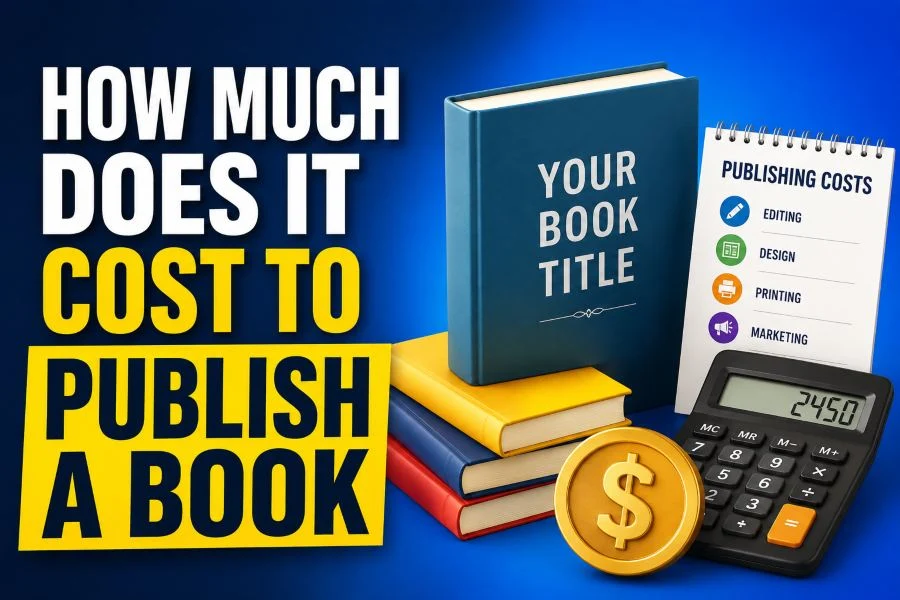
How much does it cost to publish a book depends on your publishing route, quality goals, format, and how much work you can handle yourself. In 2026, a simple DIY ebook can cost a few hundred dollars, while a professional self-published book often costs $2,500 to $6,000 before larger marketing.
This guide breaks down the real costs, hidden fees, smart savings, and break-even math so you can plan with confidence.
How Much Does It Cost To Publish A Book?
A realistic 2026 publishing budget starts with your goal, not with the cheapest upload option. You can publish on major platforms without paying a listing fee, but that does not make the book free to prepare, improve, or sell.
Most first-time authors fall into three budget levels: $200 to $500 for barebones DIY, $1,500 to $3,500 for a lean professional release, and $5,000 to $10,000 or more for a full launch. These ranges change fast when you add deep editing, illustration, hardcovers, audiobooks, or paid ads.
The main costs are editing, cover design, formatting, printing, ISBNs, proof copies, and marketing. Create KDP books, covers and others easily fits that task when you need structured support. It can reduce asset-prep time, but it does not replace editing.
Must-know Tip: “Your budget should match the promise you make to readers, because a book sold as professional needs professional editing, design, and presentation.”
Build Your Budget Around Your Goal
Your cost changes when your goal changes. A family memoir, business book, romance series, children’s picture book, and photo book do not need the same budget.
For a personal keepsake, focus on proofreading, clean layout, and a small print run. For public sales, invest in editing, genre-aware cover design, metadata, and marketing.
Common Budget Paths
A hobby author may spend $300 to $1,000 and feel satisfied if the book looks clean. A serious indie author may spend $2,500 to $6,000 because editing alone can cost $2,160 to $5,040 for an 80,000-word manuscript.
A business author may spend more because the book works as a trust asset. The return may come from leads, speaking, consulting, or authority instead of direct book royalties.
Editing Usually Takes The Largest Share
Editing is where many authors underbudget. Your manuscript may feel finished, but readers notice weak structure, repeated ideas, grammar issues, and slow chapters fast.
Developmental editing fixes structure, pacing, argument, plot, and chapter flow. Copy editing improves sentences, while proofreading catches final errors before publication.
Professional quotes often place editorial assessment near $2,000, developmental editing around $2,880, copy editing near $2,160, and proofreading around $1,600 for a full-length book. You can reduce cost by using beta readers first, then hiring an editor after your manuscript is cleaner.
Cover Design Costs More When Strategy Matters
Your cover is not decoration. It tells readers your genre, tone, promise, and quality level before they read the first page.
DIY cover tools may work for private books or very simple ebooks, but public-facing books need sharper decisions. A professional cover often lands around $630 to $1,200, with many full-service quotes averaging near $930.
Costs rise when you need custom illustration, premium typography, licensing, multiple concepts, paperback wrap design, hardcover design, or extra revisions. Good design also protects your ad budget because a weak cover makes every click more expensive.
Formatting, Layout, And File Prep
Formatting turns your manuscript into a readable product. Ebooks are simpler, while paperbacks and hardcovers need margins, page numbers, headers, trim size, bleed, and print-safe spacing.
Simple text-heavy books may cost $50 to $500 for professional formatting, or less with reliable DIY software. Cookbooks, workbooks, textbooks, poetry, and children’s books cost more because they need careful page design.
What Formatting Should Include
Your final files should include ebook, paperback, and sometimes hardcover versions. You also need a print-ready PDF, EPUB file, front matter, table of contents, and clean metadata.
Do not format too early. If you change chapters after layout, you may pay for revisions, create page-flow problems, or need a new proof copy.
Printing Choices Change The Math
Printing cost depends on page count, trim size, paper type, binding, color, and quantity. A 200-page black-and-white paperback through print-on-demand may cost around $3 to $5 per copy.
Print-on-demand works well when you want low risk. You do not need to store boxes, handle shipping, or guess demand before the book sells.
Offset or bulk printing can work when you already know you can sell through events, conferences, bookstores, or direct orders. A 500-copy bulk order may cost $2,000 to $3,000 before sales recover the spend.
Use a simple rule. Choose print-on-demand for testing and bulk printing for proven demand.
ISBN, Copyright, And Ownership Costs
ISBNs confuse many new authors because platforms can offer free identifiers. A free platform ISBN can work, but it may list the platform as the publisher.
In the United States, one ISBN often costs $125, while a block of ten costs about $295. You may need separate ISBNs for paperback, hardcover, ebook, and audiobook editions.
Copyright registration is another cost to consider. Your work has copyright when created, but formal registration gives stronger legal proof in the USA.
Check contracts before paying freelancers. Confirm who owns source files, fonts, stock images, cover files, formatted files, and audiobook masters.
Marketing Can Decide Whether The Book Sells
Many authors spend everything on production and leave nothing for visibility. That is a mistake because even a well-edited book needs readers to discover it.
A practical launch budget often sets aside 30% to 50% of the total budget for marketing when sales matter. Small ad tests may start at $50 to $100, while broader campaigns include reviews, websites, and social content.
Do not spend randomly. Start with a clear reader profile, strong description, proper categories, keywords, early reviews, and a sales page that matches the book.
Must-know Tip: “Marketing does not fix a weak book, but it can help the right book reach the right reader at the right time.”
Break-Even Math Shows The Real Risk
Your publishing cost only makes sense when you know how many copies you must sell. Break-even means total cost divided by profit per book.
If you spend $3,000 and earn $4.50 per paperback, you need about 667 sales to break even. If you earn $2.75 per ebook, you need about 1,091 ebook sales to recover the same $3,000.
Quick Break-Even Example
A $14.99 paperback may look profitable, but printing and retailer share reduce your take-home royalty. A 300-page black-and-white paperback can cost about $4.45 to print, leaving roughly $4.55 in one common royalty example.
This is why pricing, page count, and trim size matter. A longer book may look more valuable, but it can reduce profit if the printing cost climbs faster than the list price.
Hidden Costs First-Time Authors Miss
The surprise costs often appear late. You may pay for proofs, shipping, revisions, cover resizing, licenses, mockups, ISBNs, copyright registration, barcodes, and author copies.
You may also pay for beta readers, sensitivity readers, indexers, permissions, translation, audiobook production, and website tools. Paid beta readers can cost $50 to $200, sensitivity reads can cost $150 to $400, and audiobook production can run $2,000 to $5,000.
Watch revision limits closely. A designer may include two rounds, and a formatter may bill extra if you change the manuscript after layout.
DIY Tasks Versus Paid Help
You do not need to outsource everything. You should pay for the tasks where mistakes damage trust, sales, or ownership.
You can handle outlining, first revisions, metadata research, basic posts, launch checklists, and outreach yourself. Consider paid help for final editing, cover design, advanced formatting, legal permissions, and narration.
Use this decision list before spending:
• DIY when the task is low risk and easy to revise.
• Hire help when the task affects reader trust.
• Spend more when the book must compete in a crowded market.
• Save money when the book is private, experimental, or low-stakes.
Must-know Tip: “The cheapest publishing plan is not the one with the lowest invoice, it is the one that avoids expensive corrections after launch.”
A Smart Publishing Timeline
A good timeline prevents wasted money. Start with revision, beta feedback, editing, cover design, formatting, proofing, and launch preparation.
Do not buy ads before your sales page, cover, description, categories, and reviews are ready. Do not order bulk copies before you approve a proof and understand demand.
Plan payments in stages. Editing may come months before launch, design follows a stable manuscript, formatting waits for final text, and marketing continues after publication.
Instead of paying at once, many authors spread costs over 90 to 180 days.
Conclusion
How much does it cost to publish a book comes down to the level of quality, control, and sales ambition you want. You can publish cheaply, but a professional book usually needs a real budget for editing, design, formatting, printing, ISBNs, proofing, and marketing. A smart author does not ask only, “What is the cheapest way to publish?” You should ask, “What investment gives this book the best chance to satisfy readers and earn back its cost?” For most USA authors in 2026, a realistic professional budget sits between $2,500 and $6,000, with lower DIY options and higher premium paths. Spend where quality matters, save where risk is low, and use break-even math before you commit.
FAQs About Publishing Costs
Can I Publish A Book For Free?
Yes, you can upload an ebook or paperback with no upfront platform fee, but you still need money for editing, design, formatting, and marketing.
What Is The Cheapest Way To Publish A Book?
The cheapest route is a DIY ebook with self-editing, simple formatting, and a basic cover, but this works best for low-stakes projects.
How Much Should A First-Time Author Budget?
A first-time author should often budget $1,500 to $6,000, depending on genre, length, quality goals, and marketing.
Is Self-Publishing Cheaper Than Traditional Publishing?
Self-publishing usually costs more upfront because you pay for production, while traditional publishing is harder to access and gives less control.
Do I Need An ISBN?
You need an ISBN for most print editions if you want distribution, edition records, and publisher control.
How Much Does Book Marketing Cost?
Book marketing can start at $50 to $100 for small tests and rise into the thousands for broader campaigns.
Should I Pay For An Audiobook?
Pay for an audiobook when your audience listens, your genre performs well in audio, or you have a strong launch plan.
How Many Copies Do I Need To Sell To Break Even?
Divide your total publishing cost by your profit per copy. If you spend $3,000 and earn $4.50 per book, you need about 667 sales.
What Cost Should I Avoid Cutting?
Do not cut final editing and cover design too deeply because both shape reader trust before and after purchase.
Is Hybrid Publishing Worth The Cost?
Hybrid publishing can help when the company is transparent about rights, royalties, deliverables, distribution, and marketing support.